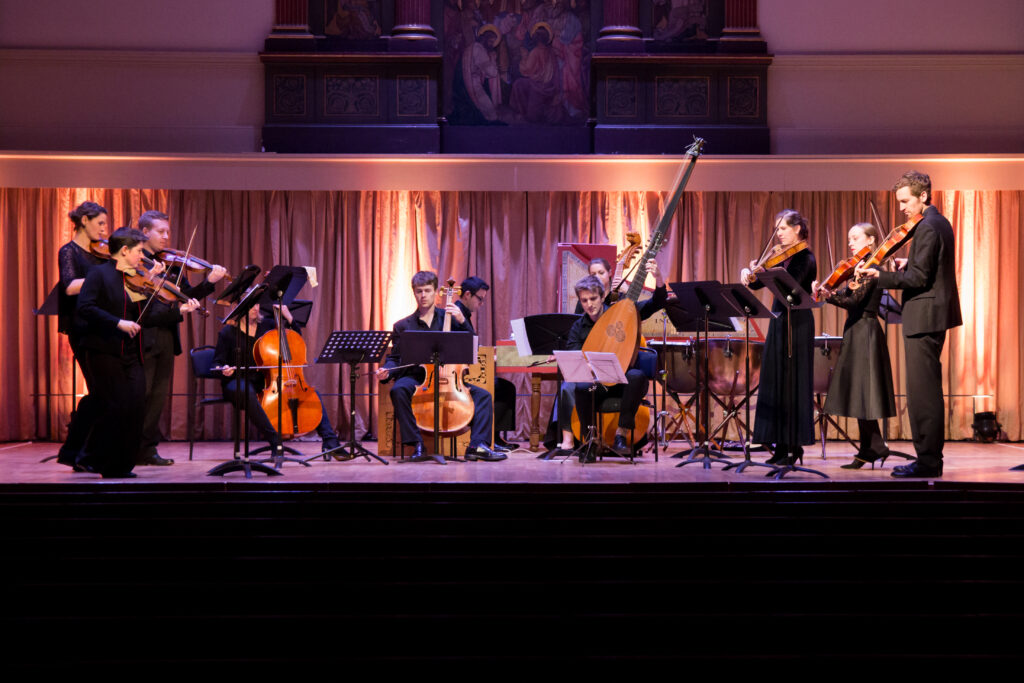
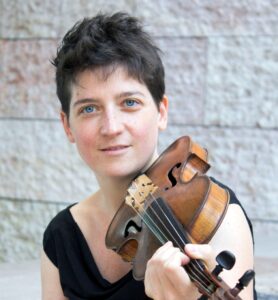
 We’re always fascinated by the way that artists put together programmes for the Festival! One of our 2026 trainees Megan Richardson chatted to violinist Kinga Ujszászi, who’ll direct The Planets with Spiritato on 3 October, about what’s coming up.
Megan: Tell me about the creation of Spiritato and its mission within the early music scene?
Kinga: We began as a small group of friends fresh out of music college and were a BREMF Young Ensemble in 2011, playing music by English Restoration composers. We took that further a few years later, making a world-premiere recording of Daniel Purcell’s Judgment of Paris. Alongside the recording, we produced our own edition from sources in the British Library, and that really set the tone for our future work: building programmes that put the composers we love into a wider musical context and trying to broaden what audiences hear. Our mission is to bring audiences new ‘old’ music and demonstrate that there are still amazing works to be discovered!
“I’ve always been fascinated by things that are much bigger than us”
Megan: What led to the creation of this programme, and how did this lead to the selection of these pieces?
Kinga: When I saw this year’s festival theme, I thought this was the perfect opportunity to make a programme based around the Harmony of the Spheres, or on the forces of nature. The night sky and the planets have inspired humans to make myths, art and music, and to try to understand the universe for thousands of years. And we’re really no different today. The 17th and 18th centuries are particularly fascinating because this was a time when our whole picture of the universe was changing. At the beginning of the 17th century, many Europeans still imagined the Earth at the centre of the universe. By the end of the century, the ideas of Copernicus, Kepler and Galileo had fundamentally changed our understanding of our place in it. So I decided to do something slightly anachronistic. Rather than choosing music representing Mars, Venus or Jupiter as the ancient gods, I took Holst’s characters and went backwards to find music from the 17th and 18th centuries that somehow embodies those characters.
The programme starts with ‘Chaos’ itself, the opening of Rebel’s Les Élémens. It is the Creation, the Big Bang, in its most elemental musical form. The opening chord, for the first time in music history, contains all twelve notes of the chromatic scale. It contains all of music! It’s like opening a box of building blocks, throwing them all onto the table, and then using them to create whatever we want.
“For most of human history, we couldn’t actually see the planets in any detail. We looked up at the sky and imagined”
Megan: Which piece do you feel best represents its respective planet, and why?
Kinga: I hope all of them! But I’m not really trying to represent the planets literally. Even in Holst’s time, people had very little idea what the planets actually looked like. Their ideas were based much more on astrology and imagination than on the kind of images we have today. We gave these celestial objects personalities and stories. That’s what I wanted to explore: not what the planets are, but what we imagine them to be. Joining these pieces together is an arrangement of a lullaby by Merula, built on a very simple ground. It becomes our musical thread, a little bit like the Promenade in Mussorgsky’s Pictures at an Exhibition. This ground is based on a single semitone, hauntingly suspended in space as we approach the different planets.
Mars, the Bringer of War – even Holst couldn’t escape the association between Mars and war. In our programme, it is an arrangement of an organ piece by Kerll. Battaglias were very fashionable organ pieces, designed to show off the different colours and stops of the instrument.
For Venus, the Bringer of Peace, we chose some beautiful instrumental music by Blow. Simple and calm.
Mercury, the Winged Messenger. For me, Handel’s overture to Acis and Galatea always feels like the opening of a modern movie. It’s quite different from his usual overtures: It doesn’t give you the usual grand French overture with dotted rhythms and a big introduction. There is no warning, no preparation – you immediately find yourself in the middle of a action where everyone is rushing somewhere. You are with Mercury, you are flying.
Jupiter, the Bringer of Jollity. I chose a movement from Castrucci’s Concerti Grossi, which we have recently recorded and which will be coming out soon on Delphian. I really love these light-hearted concerti, and it felt very appropriate to include something by him for ‘Jollity’. This particular movement has such a fun rhythmic element that it always reminds me of finger-snapping and casually walking through the streets when you have nothing to worry about. A little bit like the beginning of West Side Story.
Saturn, the Bringer of Old Age, is represented in our programme by a beautiful Lamento by Fischer. I don’t think this one needs much explanation. It is very introspective, meditative music, built around one of the best-known chorale melodies as a cantus firmus. You almost feel time slowing down.
Uranus, the Magician. This is actually a doubly perfect match. Not only does the character of the piece resemble an angry sorcerer who has to clean up after his apprentice, but the composer, William Herschel, was actually the person who discovered Uranus! This piece is slightly outside the Baroque era, but I couldn’t miss the opportunity to programme music by this fascinating scientist-composer.
Neptune, the Mystic. Well, Rameau’s music from Les Boréades is simply a glorious ending. The colours of the wind instruments and the constant suspensions in the harmony reminded me of some of Holst’s ideas for the Mystic.
Megan: This will be the 15th anniversary of your first performance at BREMF; what are you most looking forward to being back?
Kinga: We love coming to BREMF! The atmosphere is always amazing and so welcoming. The audience is incredibly friendly, and you always feel a kind of live communication with them. We love their enthusiasm and curiosity. It always feels like a conversation. BREMF audiences have been a huge support, and over the years we’ve given performances of music by Schmelzer and Vejvanovsky (Guts and Glory), Knüpfer and Pachelbel (Inspiring Bach), and we’d love people to come and discover even more in our performance on 3 October.
Megan: Is there a particular piece or passage you think the audience should specifically look forward to/listen out for?
Kinga: I wouldn’t tell them what to listen for, I’d say: enjoy the journey! Enjoy the different characters. See which one feels closest to you.
“Get lost in the music. Imagine yourself travelling through this enormous, mysterious universe. And hopefully, on the way home, you’ll look up at the sky.”
Join Kinga and Spiritato for The Planets on 3 October 2026 in St Martin’s Church, Brighton